
Could a Driverless Car Help Older Adults Stay Independent?
For many of us, getting somewhere is simple: get in the car and go.
But what happens when you stop driving?
For older adults, a trip to the doctor, grocery store, community center, or a family member’s home can suddenly require more planning. Transportation may depend on a bus schedule, a family member being available, or a specialized transportation service.
At St. Barnabas Senior Services (SBSS), we know that having reliable ways to get around is an important part of remaining independent. That is why we wanted our members to explore another option: autonomous ride-hailing.
Not as a replacement for public transportation, family, or existing transportation programs, but as one more possible way to get where they want to go.
What started as an opportunity to explore a new form of transportation also revealed a much bigger question:
As more resources become digital, what happens when the technology required to access them becomes the barrier?
Transportation Is About More Than Getting From Point A to Point B
Before trying Waymo, we spoke with members about how they currently get around Los
Angeles.
Some use buses and Metro. Others rely on family members or transportation programs like ours. Each option works differently, and each can come with trade-offs involving time, convenience, cost, and flexibility. One member explained that when taking the bus, she tries to leave about an hour early.
“Buses break down, things happen. You never know.”
Another member shared that she currently depends on public transportation and family members to pick her up.
“It bothers me...for them to do that, and I really appreciate they do it.”
These experiences point to an important part of transportation that can sometimes be overlooked: independence is not just about having a ride available. It is also about having choices.
Trying a Car Without a Driver
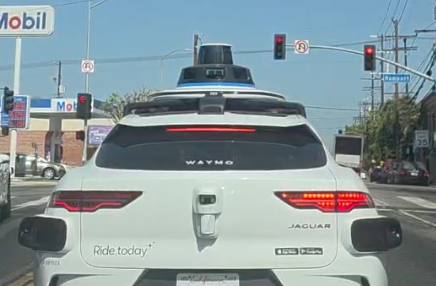
SBSS partnered with Waymo to give members an opportunity to learn about autonomous ride-hailing and experience it firsthand. For some participants, it was their first time getting into a vehicle without anyone sitting behind the wheel. Naturally, there was some hesitation.

One member described herself as both excited and scared before the ride. Another said she never imagined she would experience a car that could drive itself. But curiosity won.
“I was excited,” one participant said. “That’s an adventure for me.” After the ride, another described it as something new that she would “never forget.”
The experience gave members an opportunity to evaluate the technology for themselves rather than simply hearing about it.
And that revealed something important.
The Biggest Barrier Wasn't Necessarily the Driverless Car
For some participants, the autonomous vehicle itself was surprisingly easy to use.
The more difficult part was the smartphone. Waymo, like many modern transportation services, relies heavily on a mobile app. Riders use their phones to request a vehicle, manage their trip, locate their pickup point, and interact with the service.

For someone who is not comfortable navigating a smartphone, that can turn a convenient transportation option into a new challenge.
As one member explained:
“I'm not very good at the telephone, and you need the phone to manage all those technology. I need more practice.”
Another participant had a similar experience. Once inside the vehicle, she found many of its features straightforward. “Just press start. I mean, that was easy,” she explained.
Her challenge was getting to that point.
“It's just maneuvering on your phone to the Waymo that I'm not good at.”
That distinction matters.
A resource can exist, work exactly as intended, and have the potential to make someone's life easier. But if accessing that resource requires digital skills a person has never had the opportunity to learn, that resource may remain out of reach.
And today, that applies to far more than transportation.

Technology Education Is Access
Healthcare appointments, transportation, government benefits, banking, communication, shopping, maps, community resources, and other everyday services increasingly have a digital component.
Even emergency preparedness is becoming more connected to technology.
In Los Angeles, where communities may need to respond to wildfires, earthquakes, extreme heat, power outages, and other emergencies, smartphones can provide access to emergency alerts, evacuation information, maps, weather updates, and communication with family or caregivers.
But an emergency is not the time someone should have to figure out how to find an alert, share their location, open a map, or determine whether information online is trustworthy.
The same principle applies to everyday life. Technology can create greater independence, but only when people have the knowledge and confidence to use it.
That is why SBSS sees technology education as more than learning how to operate a device. It is about making sure older adults can access the resources and opportunities that increasingly exist behind a screen.
Does the Technology Actually Create Independence?

Digital skills were not the only consideration members discovered while testing Waymo. Pickup location, walking distance, vision, familiarity with the neighborhood, physical accessibility, smartphone confidence, and cost can all determine whether a transportation option actually works for an individual.
One participant said she could see herself using Waymo for a shorter trip but would have to consider the price for longer rides.
“The bus is the easiest and cheapest way for me to get around,” she explained.
And that is exactly the point of exploring new technology.
The question isn't whether Waymo is simply “good” or “bad.”
The question is whether it provides another useful option.
Technology does not need to replace the bus, SBSS Transportation, or a ride from a family member to be valuable. If it gives someone another way to get to an appointment, visit a friend, go shopping, or participate in their community, it can expand the choices available to them.
But first, they need to be able to access it.
Would They Use It Again?

After members completed their rides, we asked a simple question:
Would you actually use Waymo on your own?
The answers were mixed, and that made the experience even more valuable.
One participant wasn't sure because she did not yet feel comfortable enough using the smartphone app.
Another was ready to try it again.
“Next time...I'm going to use the Waymo,” he said. “I really did have a nice time. I enjoyed it.”
Another member landed somewhere in between:
“I could use it, but I have to try it a little bit more.”
Sometimes, that is exactly what learning technology looks like.
Not immediate confidence. Not mastering everything on the first attempt.
Just a little more practice, a little more familiarity, and another opportunity to try.
Aging Into the Future
That is where SBSS comes in.
The Waymo experience wasn't simply an experiment with a driverless car. It demonstrated why technology education is becoming an increasingly important part of supporting independence as we age.
Through Aging Into the Future, SBSS gives older adults opportunities to build practical technology skills and, importantly, understand how those skills connect to resources they can use in their everyday lives.
The goal isn't to teach technology for technology's sake.
It is to help someone learn to navigate a transportation app so they have another way to get around.

To use telehealth so they can connect with healthcare resources.
To recognize scams so they can navigate the internet more safely.
To use maps and location tools so they can find their way.
To access emergency information so they can be better prepared when something happens.
And to confidently explore new technologies and decide for themselves whether those tools belong in their lives.

As more of the world moves online, digital literacy is increasingly becoming a gateway to resources that support independence. Older adults should not be excluded from those resources simply because no one gave them the opportunity to learn how to access them.
At SBSS, we want to make sure they have that opportunity. Because aging into the future isn't about using every new technology that comes along.
It's about having the skills, knowledge, and confidence to access the resources you need and make your own choices about what comes next.
Learn more about St. Barnabas Senior Services at sbssla.org and Aging Into the Future at agingintothefuture.org.

Comments